Discovery of new Levantine and schematic rock art in Castelló: the Mas de la Rambla rock shelter (Portell de Morella, Els Ports, Castelló)
DOI:
https://doi.org/10.3989/tp.2024.927Keywords:
Levantine art, Schematic art, Squads of archers, Mediterranean Iberia, Post-Palaeolithic, PhotogrammetryAbstract
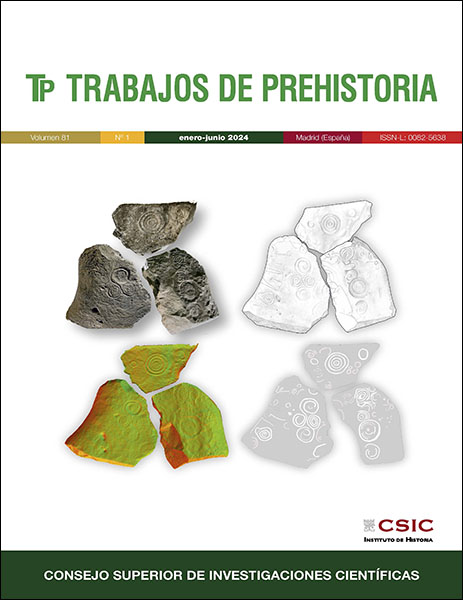
This paper reports the discovery of the Mas de la Rambla rock shelter, a new prehistoric rock art site in the province of Castelló. Altogether, twenty-nine motifs with distinctive features of two different Post-Palaeolithic artistic expressions, Levantine and schematic art, are preserved in the panel. The detailed analysis of the art and the assessment in the wider context of these two Post-Palaeolithic traditions of Mediterranean Iberia reveal both themes and characteristics already common in these styles, along with unique peculiarities. First, the geographical location, filling a gap in the spatial distribution of Levantine art, particularly among the Lower Aragón and Guadalope/Maestrazgo complex of sites in Aragón, and those of Morella la Vella, Gasulla and Valltorta and Montlleó in Castelló. Second, the geomorphological characteristics of the site, an almost vertical wall lacking the classical overhang of many Levantine rock-art sites. And finally, some of the subject matters represented, providing new evidence of a singular and restricted theme in this artistic cycle such as archers in a phalanx-like formation, as well as the overlap between Levantine and schematic motifs, almost absent in these territories and of great value to establish relative sequences.
Downloads
References
Baldellou, V. (2001). "Algunas consideraciones sobre el arte rupestre en Castellón". Quaderns de Prehistòria i Arqueologia de Castelló, 22, pp. 13-32.
Bea, M. (2019). Catálogo de yacimientos: pinturas. En: Rodanés, J. A. (Coord.). Arte rupestre en Aragón. Zaragoza: Departamento de Educación, Cultura y Deporte, Gobierno de Aragón, pp. 103-362.
Beltrán, A. y Royo, J. I. (1998). Las pinturas rupestres de la Cabecera del Barranco del Mortero, Alacón (Teruel). Zaragoza: Colección Parque Cultural del Río Martín.
Domingo, I. (2005). Técnica y ejecución de la figura en el Arte Rupestre Levantino. Hacia una definición actualizada del concepto de estilo: validez y limitaciones. València: Servei de Publicacions de la Universitat de València.
Domingo, I. (2006). "La figura humana, paradigma de continuidad y cambio en el Arte Rupestre Levantino". Archivo de Prehistoria Levantina, XXVI, pp. 161-191.
Domingo, I. (2021). "New insights into the analysis of Levantine rock art scenes informed by observations on western Arnhem Land rock art". En: Davidson, I. y Nowell, A. (Eds.). Making scenes: global perspectives on scenes in rock art. New York, Oxford: Berghahn Books, pp. 240-258. https://doi.org/10.2307/j.ctv2tsxj5z.21 PMid:33074855
Domingo, I., Carrión, B., Blanco, S. y Lerma, J. L. (2015). "Evaluating conventional and advanced visible image enhancement solutions to produce digital tracings at El Carche rock art shelter". Digital Applications in Archaeology and Cultural Heritage, 2 (2-3), pp. 79-88. https://doi.org/10.1016/j.daach.2015.01.001
Domingo, I., López-Montavo, E., Villaverde, V. y Martínez, R. (2007). Los Abrigos VII, VIII y IX de les Coves de la Saltadora. Monografías del Instituto de Arte Rupestre, 2. València: Generalitat Valenciana.
Domingo, I., Rives, B., Román, D. y Rubio, R. (2013). Imágenes en la Piedra. Arte Rupestre en el abrigo de las Monteses y su entorno (Jalance). Jalance: Ayuntamiento de Jalance/Ministerio de Cultura.
Domingo, I., Román, D., Lerma, J. L., Rodríguez, I., Zalbidea Muñoz, M. A. y Vendrell, M.(2023). "Multidisciplinary and Integral Approaches to Rock Art as a Strategy for Rock Art Conservation". En:Fernandes, A. B., Marshall, M. y Domingo, I. (Eds.). Global Perspectives for the Conservation and Management of Open-Air Rock Art Sites. Oxon, New York: Routledge, pp. 55-75. https://doi.org/10.4324/9780429355349-5
Domingo, I., Román, D. y Macarulla, A. (2020). "El abrigo de la Serradassa (Vistabella, Castelló) y su contribución a la definición del Arte Esquemático en Castelló". Zephyrus, LXXXVI, pp. 43-66. https://doi.org/10.14201/zephyrus2020864366
Domingo, I., Villaverde, V., López-Montalvo, E., Lerma, J. L. y Cabrelles, M. (2013). "Latest developments in rock art recording: Towards an integral documentation of Levantine rock art sites combining 2D and 3D recording techniques". Journal of Archaeological Science, 40 (4), pp. 1879-1889. https://doi.org/10.1016/j.jas.2012.11.024
Duarte. F. y Hernández, F. (2011). Memòria Científica. Prospecció d'urgència: Arqueologia i Etnologia. 'Catàleg de béns i espais protegits del nou Pla General d'Ordenació Urbana de Portell de Morella (Ports, Castelló)'. Inédita. Depositada en el Servei de Patrimoni de la Generalitat Valenciana.
Galiana, M.ª F. (1986). "Contribución al Arte Rupestre Levantino: análisis etnográfico de las figuras antropomorfas". Lucentum, IV, pp. 55-87. https://doi.org/10.14198/LVCENTVM1985.4.04
García-Díez, M., Garrido, D., Hoffmann, D. L., Pettitt, P. B., Pike, A. W. G. y Zilhão J. (2015). "The chronology of hand stencils in European Palaeolithic rock art: implications of new U-series results from El Castillo Cave (Cantabria, Spain)". Journal of Anthropological Sciences, 93, pp. 135-152.
Gómez-Barrera, J. A. (2021). "Un nuevo hallazgo con pinturas rupestres esquemáticas en el monte Valonsadero (Soria, España): el Abrigo de las Manos". Cuadernos de Arte Prehistórico, 12, pp. 64-95.
Guillem, P. (2005). "Las escenas bélicas del Maestrazgo". En: Martínez, R. (Coord.). Arte rupestre en la Comunidad Valenciana. Valencia: Generalitat Valenciana, pp. 239-252.
Guillem, P. M. y Martínez Valle, R. (2013). "Arte Esquemático en el abric del Castell de Vilafamés (Castellón)". En: Martínez García, J. y Hernández, M. (Coords.). Actas II Congreso de Arte Rupestre Esquemático en la Península Ibérica: Comarca de Los Vélez (mayo 2010). Vélez-Blanco: Ayto. de Vélez-Blanco, pp. 203-211.
Guillem, P. M., Martínez Valle, R. y Villaverde, V. (2010). Arte rupestre en el Riu de les Coves. Monografies de l'Institut d'Art Rupestre, 3. València: Generalitat Valenciana.
Gunn, R.G. (2006). "Hand sizes in rock art: interpreting the measurements of hand stencils and prints". Rock Art Research, 23 (1), pp. 97-112.
Hernández, M. (2006). "Arte Esquemático en la fachada oriental de la Península Ibérica. 25 años después". Zephyrus, LIX, pp. 199-214.
López, M. G., y Soria, M. (1999). La Cueva de Clarillo (Quesada, Jaén). El enigma de unas manos impresas en la Prehistoria. Patrimonio de la Humanidad. Jaén: Ed. Diputación Provincial de Jaén.
López Montalvo, E. (2007). Análisis interno del Arte Levantino: la composición y el espacio a partir de la sistematización del núcleo Valltorta-Gasulla. València: Servei de Publicacions de la Universitat de València.
López Montalvo, E. (2015). "Violence in Neolithic Iberia: new readings of Levantine rock art". Antiquity, 89 (344), pp. 309-327. https://doi.org/10.15184/aqy.2014.12
Martínez Valle, R. y Guillem, P. M. (2013). "El Arte". En: Ferrer, J. y Benedito, J. (Coords.). El arte rupestre en la provincia de Castellón: historia, contexto y análisis. Castelló de la Plana: Universitat Jaume I, pp. 113-228.
Martínez Valle, R y Villaverde, V. (2002). La Cova dels Cavalls en el Barranc de la Valltorta. Monografías del Instituto de Arte Rupestre 1. Museu de la Valltorta.
Mas, M. (Ed.). (2000). Proyecto de investigación arqueológica. Las manifestaciones rupestres prehistóricas de la zona gaditana. Sevilla: Ed. Junta de Andalucía.
Matamoros, C. y López-Mira, J. A. (2009). Gestión del arte rupestre de la Comunidad Valenciana. En: López-Mira, J. A., Matamoros, C. y Martínez, R. (Eds.). El arte rupestre del Arco Mediterráneo de la Península Ibérica. 10 años en la Lista del Patrimonio Mundial de la UNESCO. València: Generalitat Valenciana, pp. 169-178.
Mateo Saura, M. A. (2000). "La Guerra en la vida de las comunidades Epipaleolíticas del Mediterráneo peninsular". Era, 2, pp. 111-127.
Mesado, N., Andrés, X. y Barreda, E. (2001). "L'abric de Sant Pere de la Mola de la Garumba (Morella, Castellón)". Centro de Estudios del Maestrazgo, 66, pp. 67-73.
Mesado, N. y Viciano, J. Ll. (2007). "Arte rupestre en un covacho del Río Chico (Espadilla, Castellón)". Berig, 8, pp. 81-83.
Nash, G. 2005. "Assessing rank and warfare-strategy in prehistoric hunter-gatherer society: a study of representational warrior figures in rock art from the Spanish Levant, southeastern Spain". En: Parker, P. y Thorpe, I. J. N. (Eds.). Warfare, violence and slavery in Prehistory. Oxford: Archaeopress, pp. 75-86.
Porcar, J. (1944). "Pinturas rupestres arrancadas de Cueva Remígia". Boletín de la Sociedad Castellonense de Cultura, XIX, pp. 35-41.
Porcar, J. (1945). "Iconografía rupestre de la Gasulla y Valltorta. Danza de arqueros ante figuras humanas sacrificadas". Boletín de la Sociedad Castellonense de Cultura, XXI, pp. 145-152.
Porcar, J. (1970). "El más grande. Abrigo II del Cingle de la Mola Remígia". Boletín de la Sociedad Castellonense de Cultura, XLVI (II), pp. 57-60.
Porcar, J. B., Obermaier, H. y Breuil, H. (1935). Excavaciones en la Cueva Remígia (Castellón). Madrid: Junta Superior del Tesoro Artístico. Sección de excavaciones.
Rabazo-Rodríguez, A. M., Modesto-Mata, M., Bermejo, L. y García-Diez, M. (2017). "New data on the sexual dimorphism of the hand stencils in El Castillo Cave (Cantabria, Spain)". Journal of Archaeological Science: Reports, 14, pp. 374-381. https://doi.org/10.1016/j.jasrep.2017.06.022
Ripoll, E. (1963). Pinturas rupestres de la Gasulla. Monografías de Arte Rupestre. Arte Rupestre Levantino, nº 2.
Rodríguez, I. y Domingo, I. (2023). "Evaluating Thermal-Hygrometric Dynamics at a Levantine Rock Art Site. La Covatina (Vilafranca, Castelló)". En: Fernandes, A. B., Marshall, M. y Domingo, I. (Eds.). Global Perspectives for the Conservation and Management of Open-Air Rock Art Sites. Oxon, New York: Routledge, pp. 214-233. https://doi.org/10.4324/9780429355349-15
Sarriá, E. (1986-1987). "Las pinturas esquemáticas de la Galería de la Partició (Morella la Vella, Castellón)". En: Actas i Congreso Internacional de Arte Rupestre (Caspe, 1985). Bajo Aragón, Prehistoria, VII-VIII, pp. 205-210.
Sarriá, E. (1988-1989). "Las pinturas rupestres de Cova Remígia (Ares del Maestre, Castellón)". Lvcentvm, VII-VIII, pp. 7-33.
Published
How to Cite
Issue
Section
License
Copyright (c) 2024 Consejo Superior de Investigaciones Científicas (CSIC)

This work is licensed under a Creative Commons Attribution 4.0 International License.
© CSIC. Manuscripts published in both the print and online versions of this journal are the property of the Consejo Superior de Investigaciones Científicas, and quoting this source is a requirement for any partial or full reproduction.
All contents of this electronic edition, except where otherwise noted, are distributed under a Creative Commons Attribution 4.0 International (CC BY 4.0) licence. You may read the basic information and the legal text of the licence. The indication of the CC BY 4.0 licence must be expressly stated in this way when necessary.
Self-archiving in repositories, personal webpages or similar, of any version other than the final version of the work produced by the publisher, is not allowed.
Funding data
H2020 European Research Council
Grant numbers 819404
Ministerio de Ciencia e Innovación
Grant numbers PID2021-128349NB-I00
Ministerio de Ciencia, Innovación y Universidades
Grant numbers HAR2016-80693-P